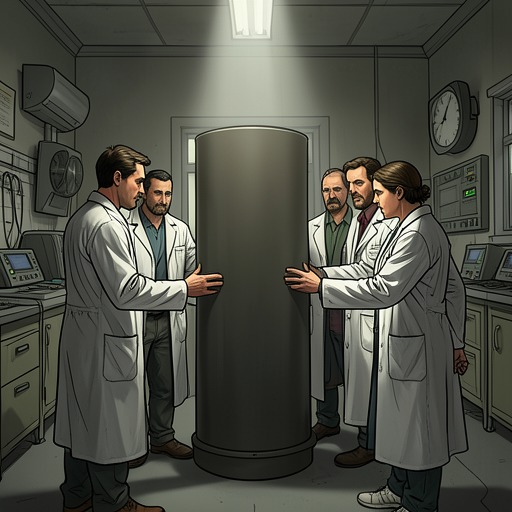
“Clean bomb”
The IPCRESS FileThe “Clean bomb” is the proposed Tokwe weapon whose defining feature was not a smaller blast but a different triggering system: the major described a fifty-megaton bomb designed to avoid the fallout associated with a conventional atomic-bomb trigger. The concept joins an extreme destructive capacity to a claim of cleanliness, and the later revelation that the weapon was modified before detonation complicates that claim.
Design and Operating Principle
The major explained that the bomb used uranium 238, which he described as cheaper than uranium 235 but requiring more energy to trigger. Rather than placing a conventional atomic bomb at the centre, the design used what he called a trigger of an entirely new pattern. The board’s central circle was left empty; the triggering apparatus was represented separately, in a small rectangle at the edge of the diagram.
That apparatus was identified as the Super Volt Micro Flash mechanism, or SUVOM. It was said to build up enough voltage for a millionth of a microsecond to trip the mechanism, with power carried into the bomb through an umbilical cord. The major’s explanation rested on the absence of the usual atomic-bomb trigger: without it, he claimed, there would be no fallout, making this the first entirely clean bomb. The designation therefore referred to the predicted absence of fallout, not to a limited explosive yield.
Scale and Detection
The projected yield was fifty megatons. The major said the bomb would produce Type 2 destruction—everything flammable destroyed and severe damage to metal and brick within a thirty-five-mile radius. His examples made the reach concrete: the effects would extend between towns in New Mexico, and another comparison ran from Southend to Reading. The contrast between a supposedly clean weapon and a blast capable of devastating an immense area is built into the briefing itself.
The weapon’s unusual design also shaped plans for detecting the test. Officers discussed jamming Russian systems that tracked changes in the ionosphere, recorded air and sound waves through microbarographs, or picked up radio signals released by an explosion. Fallout-residue analysis—the standard and most reliable way to identify the substances used in a bomb—was ruled out because the test was supposed to involve a clean bomb. The promised lack of residue was thus both a technical claim and a reason the usual means of identifying the weapon would not apply.
Modification Before the Test
Later, the narrator reconstructs what the garden party had concealed. The account he had received—that Tokwe involved a uranium 238 bomb with a SUVOM trigger—was true, but on the night of the party a team had been crash-programmed into the explosion area to modify the bomb. When he asks whether this meant the insertion of the neutron device, the Brigadier nods. The clean-bomb design had therefore been altered immediately before the test; the evidence establishes the insertion, but does not specify its technical effect on the weapon’s fallout or yield.
Meaning of the Claim
The concept’s tension lies in the distance between the word clean and the weapon described: a fifty-megaton explosion with a thirty-five-mile radius of severe destruction is called clean because its proposed triggering method was expected to leave no fallout. The detection briefing gives that claim operational importance, since it excludes residue analysis even as officers prepare to interfere with other forms of monitoring. The subsequent disclosure of a last-minute neutron-device insertion makes the original description a partial account of the test, not the whole story.